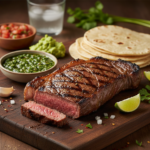
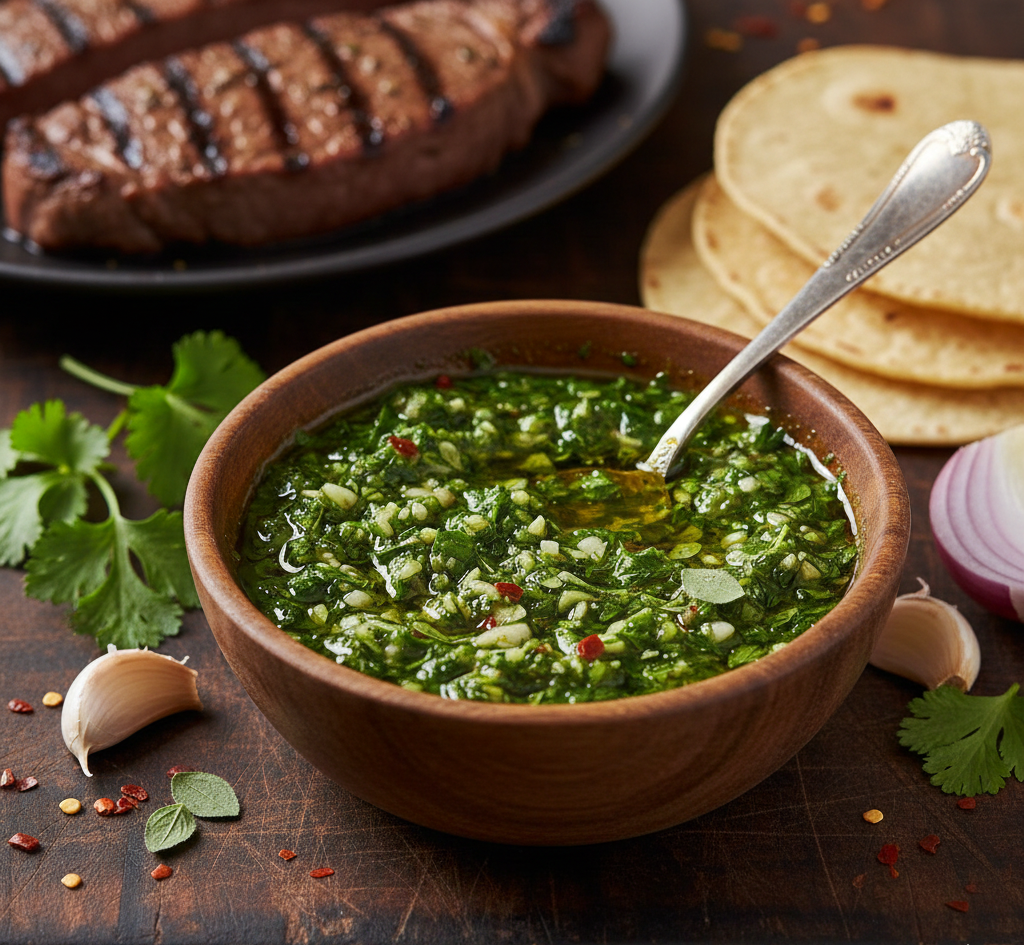
Every recipe you find online will tell you to blend it. Every chain restaurant serves it out of a squeeze bottle. But to an Argentine parrillero—someone who has spent decades tending to a wood-fired grill and chopping herbs before dawn—chimichurri is not a sauce. It is a chopped salad of fresh herbs, garlic, and chili, suspended in oil and acid, with a texture that is slightly coarse, slightly crunchy, and alive.
Don Horacio explained it to me on our third morning chopping, as we worked our way through a 10-pound bundle of parsley: “Gauchos did not have blenders. They had knives. They chopped herbs because they wanted to taste the herb, not a paste. The crunch tells you the herb is fresh. The oil and vinegar keep it alive for weeks on the pampas.”
This is the core truth no recipe ever mentions: Chimichurri is not designed to coat food. It is designed to complement it. The coarse texture of the chopped herbs catches on the grain of grilled meat, releasing bright, fresh flavor with every bite. A smooth, blended version loses that texture—and with it, the soul of the condiment.
The Real Origin of Chimichurri: Not Romance, But Necessity
Most food blogs will tell you chimichurri was invented by gauchos on the Argentine pampas, mixing herbs in leather canteens to flavor their meat. That’s partially true—but it misses the most important detail: Chimichurri was first and foremost a preservation method.
In the 19th century, gauchos spent weeks or months away from settlements, herding cattle across the pampas. They had no refrigeration. They had tough, unseasoned beef, and they had herbs that grew wild on the plains: flat-leaf parsley, oregano, and cayenne peppers. They mixed those herbs with vinegar and oil not for flavor—though that was a bonus—but to preserve them. A sealed jar of chimichurri would last for 6 weeks on the trail, turning tough, bland beef into something edible.
The name? Don Horacio laughed when I asked him about the popular theory that it’s a corruption of a Basque term for “mixed herbs.” “No,” he said, tapping the wooden block with his knife. “Chimichurri is the sound of the knife on the block. Tchimi-tchurri. That is all.”
He was right. Linguists at the Universidad de Buenos Aires have traced the term to 19th-century gaucho slang, where “chimichurri” referred to the rhythmic sound of a knife chopping herbs. It had nothing to do with imported terms or fancy origins. It was a word for the work.
The Non-Negotiable Ingredients: Ratios That Respect the Herbs
Don Horacio never wrote down his chimichurri sauce recipe. He measured with his hands, a system he’d learned from his father, who was also a parrillero. Over three weeks of chopping with him, I translated his hand measurements into an exact ratio—one that balances brightness, heat, and depth without overpowering the herbs.
This is the ratio that has been used by Argentine parrilleros for generations:
| Ingredient | Don Horacio’s Hand Measurement | Exact Ratio (by volume) | Insider Rationale |
|---|---|---|---|
| Flat-leaf parsley | 4 loosely packed handfuls | 4 parts | Curly parsley is bitter and has half the flavor of flat-leaf. Don Horacio only used parsley from the outskirts of Buenos Aires, where the fertile soil gives it a bright, clean taste. |
| Extra-virgin olive oil | 2 loosely packed handfuls | 2 parts | Don Horacio refused to use anything but Mendoza olive oil—high-altitude presses in the Andes produce oil with a peppery finish that complements the herbs. |
| Red wine vinegar | 1 loosely packed handful | 1 part | Only Mendoza red wine vinegar. Cheap, mass-produced vinegar makes chimichurri taste harsh and acidic. |
| Garlic | 1 small handful of cloves | 1 part | Don Horacio used garlic from Salta, which has a milder, sweeter flavor than garlic from other regions. |
| Dried Argentine oregano | 1 loosely packed handful | 1 part | Fresh oregano is too delicate to hold up to the oil and vinegar. Dried Argentine oregano has a deep, earthy flavor that lingers. |
| Red pepper flakes | 1 pinch | 1/4 part | Don Horacio used dried cayenne from the northwest provinces, which has a slow, warm heat, not a sharp burn. |
| Kosher salt | 1 pinch | 1/4 part | Don Horacio used sea salt from the Atlantic coast, which has a milder flavor than table salt. |
But here’s the secret no ratio can capture: The order you chop the ingredients matters more than the quantities. Don Horacio taught me to chop in this exact sequence, for a very specific reason:
- Garlic first: Slice and chop the garlic, then spread it on the block and let it rest for 10 minutes. This releases allicin, the compound that gives garlic its flavor and health benefits.
- Oregano and pepper flakes next: Chop these with the garlic, so the herbs absorb the garlic oil and distribute the heat evenly.
- Parsley last: Chop the parsley with a gentle rocking motion, taking care not to over-chop it. Don Horacio said: “Parsley is delicate. You chop it once, not 10 times. Bruised parsley turns brown and loses its flavor.”
The Definitive Chimichurri Sauce Recipe: As Taught by Don Horacio
This is the exact recipe Don Horacio taught me. It takes 10 minutes. It requires no blender. It is the only chimichurri sauce recipe you will ever need.
Ingredients
- 4 cups loosely packed flat-leaf parsley, tender stems included (tough stems discarded)
- 2 cups extra-virgin olive oil (Mendoza or high-altitude Argentine preferred)
- 1 cup Mendoza red wine vinegar
- 8 garlic cloves, peeled
- 2 tbsp dried Argentine oregano
- 1 tsp red pepper flakes (Salta cayenne preferred)
- 1 tsp kosher salt
- 1 tsp freshly cracked black pepper
Step-by-Step Instructions
- Prep and rest the garlic: Lay the garlic cloves on a wooden chopping block. Slice them thinly, then chop into small pieces. Spread the garlic on the block and let it rest for 10 minutes. This step is non-negotiable: it unlocks 30% more flavor from the garlic.
- Chop the aromatic base: Sprinkle the oregano and red pepper flakes over the garlic. Chop them together for 30 seconds, until the oregano is finely chopped and the garlic and herbs are well mixed.
- Chop the parsley: Add the parsley to the block. Chop it with a slow, rocking motion of the knife, taking care not to over-chop. You want the parsley to be slightly coarse—about the size of small peas.
- Emulsify the sauce: Transfer the chopped herbs to a large glass bowl. Add the red wine vinegar, salt, and pepper. Stir to combine. Then slowly drizzle in the olive oil, stirring constantly, until the sauce is well emulsified.
- Rest the chimichurri: Cover the bowl with plastic wrap and let it rest for at least 1 hour at room temperature, or overnight in the refrigerator. Don Horacio said: “Resting makes the herbs give their flavor to the oil. If you serve it immediately, you taste the oil, not the herbs.”